On January 28, 2026, the Ministry of Environment, Forest and Climate Change quietly published a document that changes the rules of waste management for every household, business, and institution in India. The Solid Waste Management Rules, 2026 came into full effect on April 1, 2026 — replacing the decade-old 2016 framework with a sharper, more enforceable, and more comprehensive approach.
If you live in Delhi NCR, this affects you directly.
Why the 2016 rules weren't enough
India's 2016 Solid Waste Management Rules introduced the concept of source segregation and expanded waste governance beyond just municipalities. On paper, they were progressive. In practice, compliance was uneven at best.
Segregation remained inconsistent across cities. Urban Local Bodies bore all the responsibility while citizen accountability stayed low. Landfills continued to receive mixed, unprocessed waste. Delhi's Ghazipur landfill — now taller than the Qutub Minar — became a symbol of what happens when collection outpaces processing.
Green Fact
India generates approximately 1.85 lakh tonnes of solid waste per day. Only 61% is currently processed — and poor source segregation is the leading reason.
The 2026 rules are a direct response to nearly a decade of frustration with what good regulations look like on paper versus what actually happens on the ground.
The biggest change: four-stream segregation
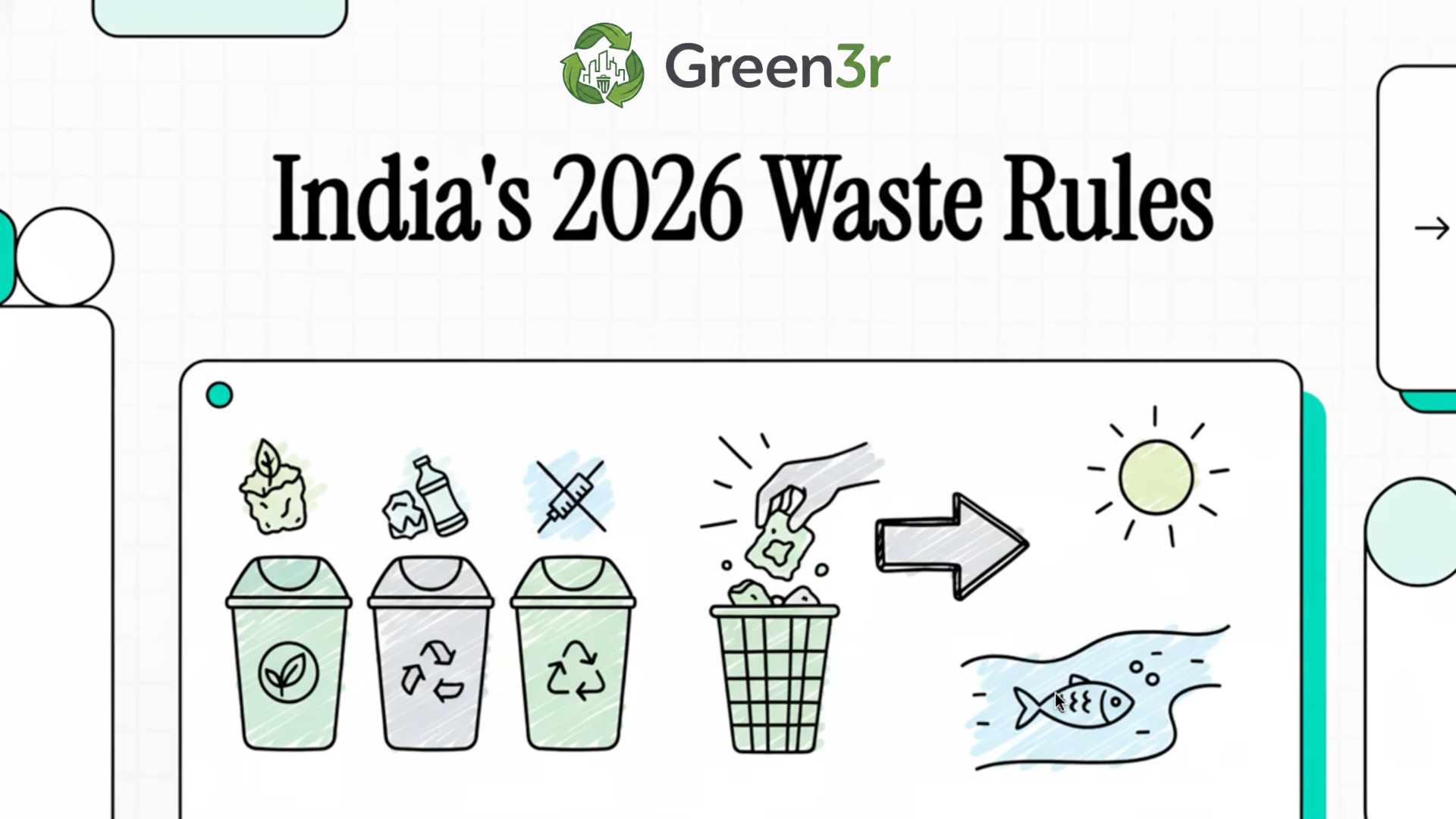
The most significant shift in the new rules is moving from a two or three-bin system to mandatory four-stream segregation at source — for every household, institution, and business in India.
The four streams are:
Wet Waste — Kitchen scraps, food leftovers, vegetable peels, flowers, garden trimmings. Anything organic that will decompose.
Dry Waste — Plastic bottles, paper, cardboard, glass, metal, fabric. Clean, dry materials that can be recycled.
Sanitary Waste — Diapers, sanitary napkins, tampons, bandages. Items that cannot be composted or recycled and require separate safe disposal.
Special Care Waste (Domestic Hazardous Waste) — Paints, medicines, batteries, lightbulbs, pesticide containers, e-waste. Items that are toxic if they enter regular waste streams.
Tip
Most households already manage wet and dry reasonably well. The two new additions — sanitary and special care waste — just need two extra small bins and a bit of habit adjustment.
What this means for you at home
For most households, the practical change is straightforward: four bins instead of two.
Wet and dry you likely already have. The additions are a small lined bag for sanitary waste and a dedicated container — a box or bag works fine — for things like dead batteries, expired medicines, and broken CFL bulbs.
The rules also reinforce what Green3r users are already doing: waste must be handed over only to authorised collectors, and mixed waste sent to landfills will now attract higher disposal fees. The economic incentives now align with the environmental ones.
4
mandatory waste streams from April 2026
62M+
tonnes of waste India generates annually
₹1000+
potential fines for non-compliance
Bigger accountability for bulk generators
One of the most consequential new provisions is Extended Bulk Waste Generator Responsibility (EBWGR). Under this rule, large waste producers — housing societies, hotels, hospitals, malls, schools, markets, airports — are now legally responsible for ensuring their waste is collected, transported, and processed correctly.
These entities must obtain an EBWGR certificate and cannot simply pass the problem downstream to Urban Local Bodies. This shifts waste management from being a municipal service to a shared legal responsibility — a significant philosophical change in Indian environmental regulation.
Digital tracking and the centralised portal
The 2026 rules introduce a centralised online portal operated by the Central Pollution Control Board (CPCB). Every stage of waste management — from generation to final disposal — will be tracked, registered, and reported through this system.
Waste processing facilities must submit reports online. Audits are now mandatory. The data will be publicly available, introducing a layer of transparency that the 2016 framework never had.
Green Fact
Local bodies that send unsegregated waste to landfills will face higher landfill fees under the new rules — a direct financial penalty for poor compliance.
Strict limits on landfilling
Landfills in India have historically received everything. That changes under the 2026 rules.
Landfills will now accept only non-recyclable, non-energy-recoverable dry waste and inert material. Wet waste cannot go to sanitary landfills at all. Legacy dumpsites must be geographically mapped by October 2026 and remediated through biomining in a time-bound manner.
This means that upstream segregation is no longer just an environmental best practice — it is the legal foundation on which the entire downstream system depends.
What Green3r users are already doing right
If you're a Green3r user in Delhi NCR, you're ahead of most of India on this.
Daily segregated pickups — wet and dry — are already built into Green3r's system. The 2026 rules provide the national regulatory backing for exactly this kind of structured, consistent, source-level segregation. As the four-stream system rolls out, Green3r's collection model is designed to evolve with it.
The points, streaks, and badges aren't just gamification — they track real, compliant behaviour that now has legal significance.
The Solid Waste Management Rules, 2026 mark a genuine shift in how India treats waste — from a municipal inconvenience to a shared responsibility with teeth. The rules are clear. The penalties are real. And the starting point, as always, is what happens at your door.
🌱 Green3r App
Already segregating? Green3r makes sure it counts — download the app today
Free on iOS & Android · Delhi NCR & nearby cities